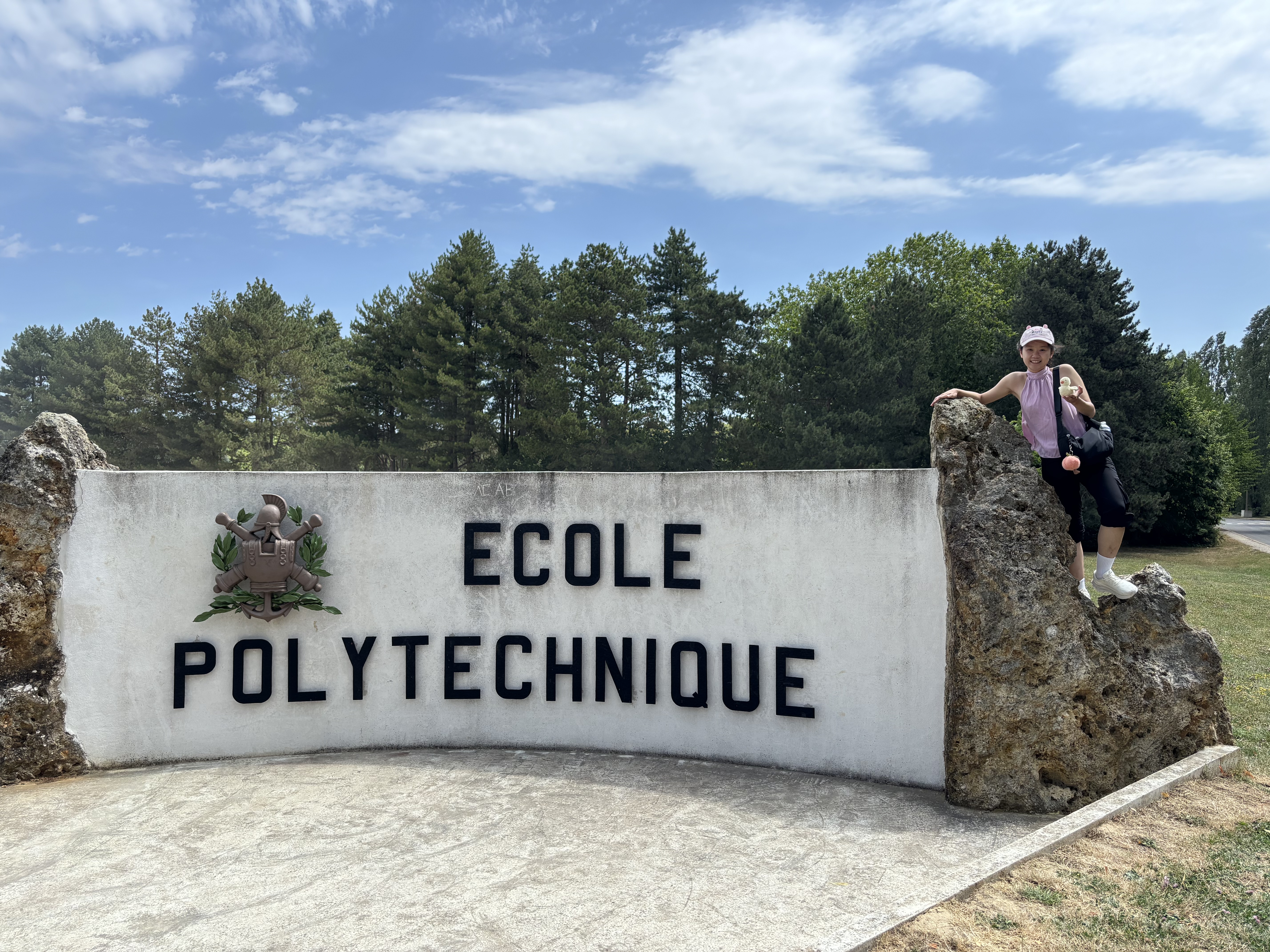
In the middle of the Paris heatwave, I spent two weeks (while trying not to melt) attending the XIVth Fluid Dynamics of Sustainability and the Environment (FDSE) Summer School at École Polytechnique in Palaiseau, France. The summer school is co-organized each year by faculty members and researchers from the University of Cambridge and École Polytechnique. It brings together PhD students and early-career researchers from diverse backgrounds in Earth sciences, engineering and mathematics. This two-week program consisted of classroom lectures, numerical project work, small-group experiments, and some social events. Overall, this summer school was an enriching experience that deepened my understanding of geophysical fluid dynamics and allowed me to engage with people from all over the world, fostering valuable academic connections and collaborations.
Over the two weeks, multiple poster sessions were held for the participants to share their work with one another and the participating professors. I had the opportunity to give a poster presentation on my first PhD project, titled “using the geostrophic drag law to better represent the ocean current feedback in ocean-only simulations”. The work proposed a theoretically based wind stress formulation to better represent the damping effect of surface currents on ocean eddies. The session sparked meaningful discussions, making it my first opportunity to share this project with people outside McGill—and the conversations were incredibly fruitful. The diverse research backgrounds of the participants brought many new perspectives. I met people studying similar eddy damping processes and others applying adapted versions of quadratic drag laws to sea ice, while also learning from people working on atmospheric dynamics, smaller lake systems, and climate models. Even more fascinating were the conversations with those analyzing their own in-situ measurements collected during research cruises. These interactions with such passionate and creative minds were truly inspiring and gave me new perspectives on my own research.
Living up to the expectations of an intensive summer school, the FDSE program offered a comprehensive series of lectures focused on the fundamentals of geophysical fluid dynamics and several emerging challenges in the field. The 30 lectures were compactly scheduled throughout the mornings of the two-week program, covering essential topics including atmospheric and oceanic dynamics, overviews of the cryosphere and renewable energy, as well as special invited talks on tsunamis, storm surges, urban flows and air quality, and other related topics. Despite enduring the intense heat in some crowded classrooms without functioning AC, I could still feel my mind being enriched by the knowledge, passion, and dedication of the lecturers. Four afternoons were dedicated to numerical labs, with hands-on activities that provided a refreshing break from the long lectures and allowed us to put concepts into practice. The numerical practicals were particularly relevant to my oceanography background, as we explored the propagation and dispersion of linear waves, basic processes in the rotating shallow water model, buoyancy-driven flows, and the relationship between transport and mixing using Python codes developed by the lecturer.
A highlight of this program was the small-group practical laboratory experiments. We were assigned to two different labs, each with three people, based on our preferences. The first lab I joined investigated the response of a laboratory aquifer to artificial rainfall. I had the chance to measure the porosity and the conductivity of the porous medium and compare our measurements with textbook values. Switching on the water pump and measuring the weight of the water flowing out of the aquifer, we were able to calculate and plot the evolution of discharge over time. From the resulting stream hydrograph, we could identify the storm flow regime and the drought regime and fit a power law to describe the discharge behavior. Even though we conducted the experiment very carefully, there was a large discrepancy between the theoretical results and our lab data in the drought regime, which made me realize how challenging experimental work could be. Another interesting part of this lab was the deep aquifer simulation at the end, where we generated a chronophotograph to visualize the groundwater flow streamlines. The second experiment I participated in focused on the properties of surface gravity waves and Stokes drift as functions of wave characteristics using a wave tank apparatus. Both lab instructors were extremely helpful and patient, making the hands-on experiments a valuable learning experience.
The cool evening breeze made outdoor activities even more enjoyable at the École Polytechnique campus. Over the two weeks, I explored the campus, took trail walks around the lake, watched geese, joined outdoor barbecues, went on night runs, played frisbee, learned pétanque, and chatted about everything from science to daily life with other participants. We also had a free weekend to explore Paris on our own. It was through these memorable moments outside the classroom that our friendships grew. I am grateful for all the wonderful people I met during the program, and the memories we shared will stay with me for a lifetime.
Last but not least, I truly appreciate the financial support from the QCS Conference Travel Award, which made this experience possible. The two weeks were an incredibly rewarding and intellectually stimulating journey. The lectures, discussions, lab sessions, and bonds I formed with people from diverse backgrounds will undoubtedly continue to inspire me in the future.