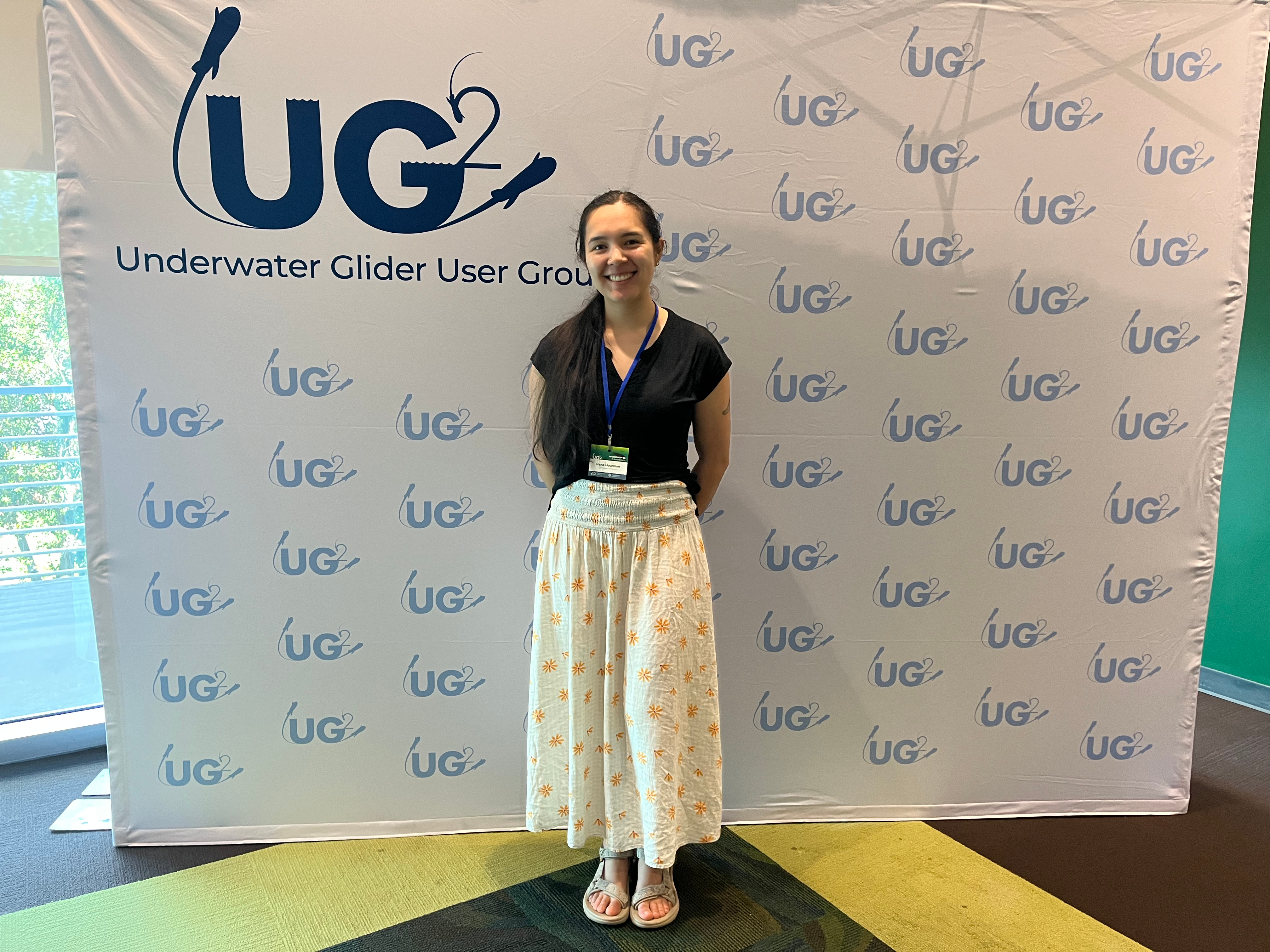
Putting my fear of alligators to the side, I travelled to St. Petersburg, Florida, to attend the Underwater Glider User Group (UG2) Workshop in May 2026. Gliders are torpedo-shaped autonomous profiling platforms to which sensors can be affixed to measure physical and biogeochemical water properties, record passive acoustics, and photograph plankton. The UG2 Workshop brings together oceanographers, biologists, data specialists, and industry representatives to network and to discuss scientific research, operations, data management, and training involving gliders. This was a great opportunity for me to share my glider-based observations of water masses on the Scotian Shelf, connect with others who use gliders and make sensors for them, and get advice on processing data from these sensors. I originally applied to show a poster, but I instead gave a 10-minute talk in the Climate Trends and Regional Oceanography session after a spot opened up. The section of my talk on warming trends felt on-theme with the heat that St. Petersburg experienced that week.
The Climate Trends and Regional Oceanography session contained talks on several different long-term monitoring programs that use gliders. One talk was on glider-based monitoring of the California Current, which is nearing its 20th year of operation. Observations from regular shelf transects in this program have helped increase understanding of the physics behind coastal upwelling, which supports primary productivity through the transport of nutrients to the photic zone. Other programs based in Mexico and the eastern U.S. observe the Loop Current in the Gulf of Mexico and the Gulf Stream, respectively, and have both been active for about 10 years. Near real-time temperature observations from these gliders have been used to estimate heat transport in these regions where hurricane formation and displacement are serious concerns. It was inspiring to see how far glider operations have come in the past two decades and interesting to compare operations between programs.
The workshop offered additional support for students and early-career researchers such as myself. One of these supports was getting matched with a mid-career scientist who I was given time to meet with on the first day and ask questions of. I also opted in to receive personalized feedback on my presentation from a panel of other attendees to help me improve my science communication skills. For everyone who attended, “glider bingo” encouraged us to get to know each other by finding people at different career stages and with different types of glider or sensor experience matching a box on our sheets. While I didn’t win bingo, I was grateful to connect with members of the UG2 community who I might not have otherwise!
UG2 was the first conference I’d attended as a graduate student at Dalhousie University, and I would like to acknowledge NSERC CREATE for supporting my travel to this event. The relatively small size of the workshop (145 attendees), the extra support for early-career researchers, and the emphasis on making connections made it an ideal first conference for me. Networking with fellow oceanographers yielded helpful insights into common sensor processing issues as well as ideas on how to expand on facets of my project. Overall, the experience was well worth it (and no alligators were sighted!).